
Why does choosing the right Google Ads account matter from the very beginning?
When businesses first start with Google Ads, they often focus only on the product, ad creatives, or budget while overlooking the account foundation itself. In reality, the type of account you use directly affects operations, billing, stability, and even how easily you can scale later on.
If you choose the wrong account from the start, the business usually falls into one of two inefficient situations: either using an account that is too weak for a growth phase that needs scale, or using an account that is too advanced while the model is still being tested. Both waste resources, just in different ways.
- The account type affects billing, operations, and campaign scaling capacity.
- Choosing the wrong account can lead to extra trial-and-error costs or instability during growth.
- The strongest account is not always the most suitable account.
- The right mindset is to choose based on the business stage, not based on hype.
What Google Ads account options do businesses actually have?
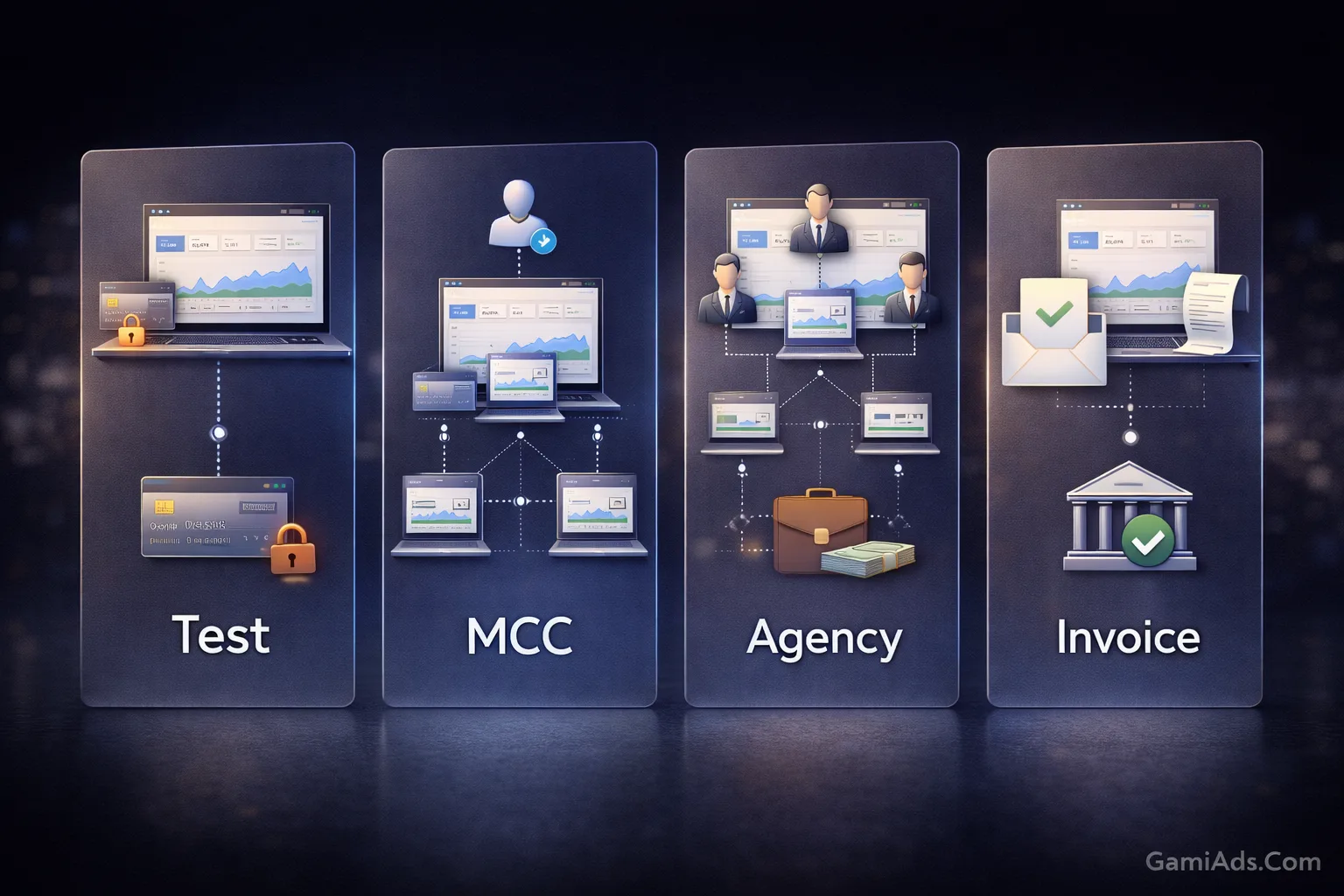
In general, businesses usually encounter four common options: standard Google Ads accounts, accounts managed under an MCC structure, Agency accounts, and Invoice accounts. Each group has its own strengths in terms of control, flexibility, billing model, and suitability for different operating models.
Standard accounts are usually better for smaller and simpler needs. MCC works better when multiple accounts must be managed centrally. Agency accounts are strong when flexibility is needed across multiple projects or clients. Invoice stands out for its postpaid model, higher stability, and better fit for larger budgets. The key is understanding these differences before making a decision.
- Standard accounts are better suited to simpler needs and early-stage operations.
- MCC is a management layer and is useful when multiple accounts need to be handled centrally.
- Agency accounts are often more flexible for multiple projects, products, or clients.
- Invoice accounts are better suited to businesses that need structured billing and larger-scale operations.
Stage 1: When the business is still testing the market, which account makes the most sense?
At the beginning, the most important goal is usually not aggressive scale, but accurate testing, fast learning, and keeping experimentation costs reasonable. At that stage, a standard Google Ads account or another simple testing-friendly setup is often the more practical choice, because the business needs flexibility and does not yet need the added complexity or cost of higher-level account structures.
If the product has not yet proven itself, moving too early to a stronger account foundation often brings little real benefit. At this stage, the real bottleneck usually lies in the offer, creative, landing page, or campaign structure, not in the account type itself.
- At the testing stage, flexibility and reasonable cost usually matter most.
- There is no need for a stronger and more complex account setup if the model is not proven yet.
- The focus should be on finding a winning product and a viable conversion path first.
- The right account at this stage is one that supports learning and optimization, not one that looks impressive.
Stage 2: Once the business starts growing, what becomes a better fit?
When a business already has campaigns performing well, enough data to optimize, and a need to increase budget more steadily, the account requirements begin to change. At that point, stability, clearer account structure, and better control start to matter more than they did during the testing phase.
If the business is managing multiple accounts, product lines, or coordination between media buyers and managers, an MCC system or an Agency account often becomes a better fit. This is the stage where the business moves from testing into a more structured operating model, so the account foundation needs to mature along with it.
- Once growth begins, businesses need more stability than simplicity alone.
- MCC is a good fit when multiple accounts need to be managed in one centralized structure.
- Agency accounts are a better fit when more flexibility is needed across products, projects, or clients.
- This is the stage where the business should start optimizing the operating foundation, not just individual campaigns.

Stage 3: When the business wants to scale aggressively, should it move to Invoice?
When budgets start rising sharply, billing becomes more complex, and the business needs a more deliberate operating system, Invoice often becomes a strong option to consider. Its biggest advantage lies in postpaid billing, clearer financial processes, and a stronger fit for larger spending needs, especially when the business is preparing for serious expansion.
That said, Invoice is not the answer to every problem. If the campaign is not yet winning, the landing page is still weak, or the business does not truly need large-scale spend yet, moving to Invoice too early can make the operating model heavier than necessary. It only makes sense when the real bottleneck has shifted to the account foundation rather than the basic advertising strategy.
- Invoice is a better fit once the business has clearly entered a scaling phase.
- Its main strengths are postpaid billing, better stability, and support for larger spend.
- It should not be used too early if the business model is still unproven.
- Invoice is a tool to raise the operating ceiling, not to rescue a weak campaign.
Three questions that help a business know which account it should use
To choose the right Google Ads account, a business can start with three practical questions. First, what stage is the business in right now: testing, growing, or scaling hard? Second, is the current bottleneck in advertising strategy or in the account foundation itself? Third, does the team need flexibility, stronger control, or a more structured billing process?
Once those three questions are answered, the right choice usually becomes much clearer. A business that is just testing does not need the same account structure as an agency managing multiple clients. In the same way, a company preparing for heavy spend and formal invoicing should not keep relying on an account foundation that is too basic for its current needs.
- Start by identifying the current stage of business growth.
- Decide whether the real bottleneck is strategy or account infrastructure.
- Clarify whether the team needs flexibility, control, or stronger financial processes.
- The right answer usually comes from real operating needs, not from the reputation of the account type.

Common mistakes businesses make when choosing a Google Ads account
The first mistake is choosing based on hype. Many businesses hear that a certain account type is stronger and immediately want to use it, without comparing it to their actual needs. The second mistake is choosing only because it is cheaper, even though the account foundation is a long-term operating asset and should not be decided by a small short-term price difference.
The third mistake is using an account that is too advanced for a business that is still too early, or the opposite, staying on an account that is too weak when the company has already reached a stage that requires scale. Both create friction in growth. A healthy operating system always starts with fit, not extremity.
- Do not choose an account type just because people say it is stronger.
- A lower price is never enough by itself to justify a long-term account decision.
- Using an advanced account too early or a weak account too late both reduce growth efficiency.
- Fit matters far more than the feeling of owning a premium account type.
Conclusion: choosing the right Google Ads account means choosing the right pace for business growth
If you look at it correctly, choosing the right Google Ads account is not just a technical question. It is an operating decision. The account you use reflects how the business is growing, how budgets are managed, and how the team works together over the long term.
So instead of asking which account is the strongest, it is better to ask which account is the most suitable for the current stage. When the fit is right, the business operates more smoothly, more steadily, and scales more easily. When the fit is wrong, even a strong campaign structure can be slowed down by the wrong foundation underneath it.
- Choosing an account means choosing an operating foundation for the current stage.
- There is no single best Google Ads account for every business.
- The right fit helps businesses operate more smoothly and scale more sustainably.
- A correct decision at the account-foundation level can save a great deal of trial-and-error cost later.
Frequently Asked Questions
Which Google Ads account type should a new business start with?
At the beginning, businesses are usually better off with a simpler and more flexible account setup that supports market testing. If the model has not yet been proven, there is usually no need to move into a stronger and more complex account structure too early.
When should a business consider using an Agency account or MCC?
Once the business starts managing multiple accounts, product lines, or needs a more structured operating setup, MCC or Agency accounts often become more suitable. This is the stage where centralized management begins to matter more.
Is an Invoice account suitable for every business?
No. Invoice is generally a better fit when the business already has large spending needs, wants a clearer billing process, and is entering a more serious scaling phase. If the business is still testing, moving to Invoice too early is usually not the best choice.
What is the most important factor when choosing a Google Ads account?
The most important factor is how well the account matches the business’s current stage of development. The right choice should be based on whether the company is still testing, already growing, or ready to scale, rather than on hype or prestige.
What is the most common mistake businesses make when choosing a Google Ads account?
The most common mistake is choosing based on hype or price alone. Many businesses fail to evaluate their real operating needs, so they end up with the wrong account type—either wasting resources or lacking the right foundation when growth actually begins.