
Why do so many advertisers confuse Google Invoice accounts with Agency accounts?
Once advertisers move beyond standard personal Google Ads accounts, they often start looking for stronger account types to handle larger budgets, tougher niches, or more stable scaling. At that stage, the two options most commonly mentioned are Google Invoice accounts and Agency accounts.
What makes them easy to confuse is that both are seen as premium resources with strong trust levels and are often used inside professional advertising systems. But they are not the same by nature. If you choose the wrong type from the start, you may end up with an account setup that does not fit your workflow, a billing structure that limits flexibility, or unnecessary operating costs.
- Both Invoice and Agency accounts are stronger than standard accounts in many advertising situations.
- The core differences lie in account origin, billing structure, and operational flexibility.
- Neither option is universally better; the right choice depends on your business model.
- Understanding the difference early helps you choose more accurately and avoid costly trial and error.
What is a Google Invoice account?
A Google Invoice account is an ad account that operates on a spend-first, pay-later model through invoicing. Instead of manually prepaying before ads run, the business is given a credit line and settles payments on a billing cycle or after reaching an agreed threshold.
The biggest advantage of an Invoice account is its very high trust level and its ability to support large budgets more steadily. This type of account is usually a better fit for businesses with significant advertising spend, structured finance processes, and a need for a more professional payment model than standard prepaid accounts.
- The core model is spend first, then pay later through invoices or a credit limit.
- It is generally more suitable for larger businesses or systems that require strong and stable budgets.
- Its trust level is often very high, which is why many advertisers prefer it when scaling.
- This is not always an account type that every advertiser can access directly or easily.

What is a Google Agency account?
A Google Agency account usually refers to an advertising account that operates under a larger management structure, most commonly an MCC setup. This type of account is designed so agencies or ad management teams can monitor, assign access, and optimize multiple child accounts within the same system.
One of the most valuable strengths of an Agency account is flexibility. It can be used across multiple websites, multiple projects, or multiple clients while still allowing centralized control. For teams that need to turn campaigns on and off quickly, separate budgets by case, and adapt fast across different accounts, Agency accounts are often the more practical choice.
- Agency accounts are commonly tied to MCC systems for centralized management of multiple child accounts.
- They are a strong fit for teams, agencies, or advertisers handling multiple projects at once.
- Their main advantage is operational flexibility and easier account management.
- Billing is often handled by the agency or the resource provider behind the account.

Google Invoice account vs. Agency account: comparing the most important factors
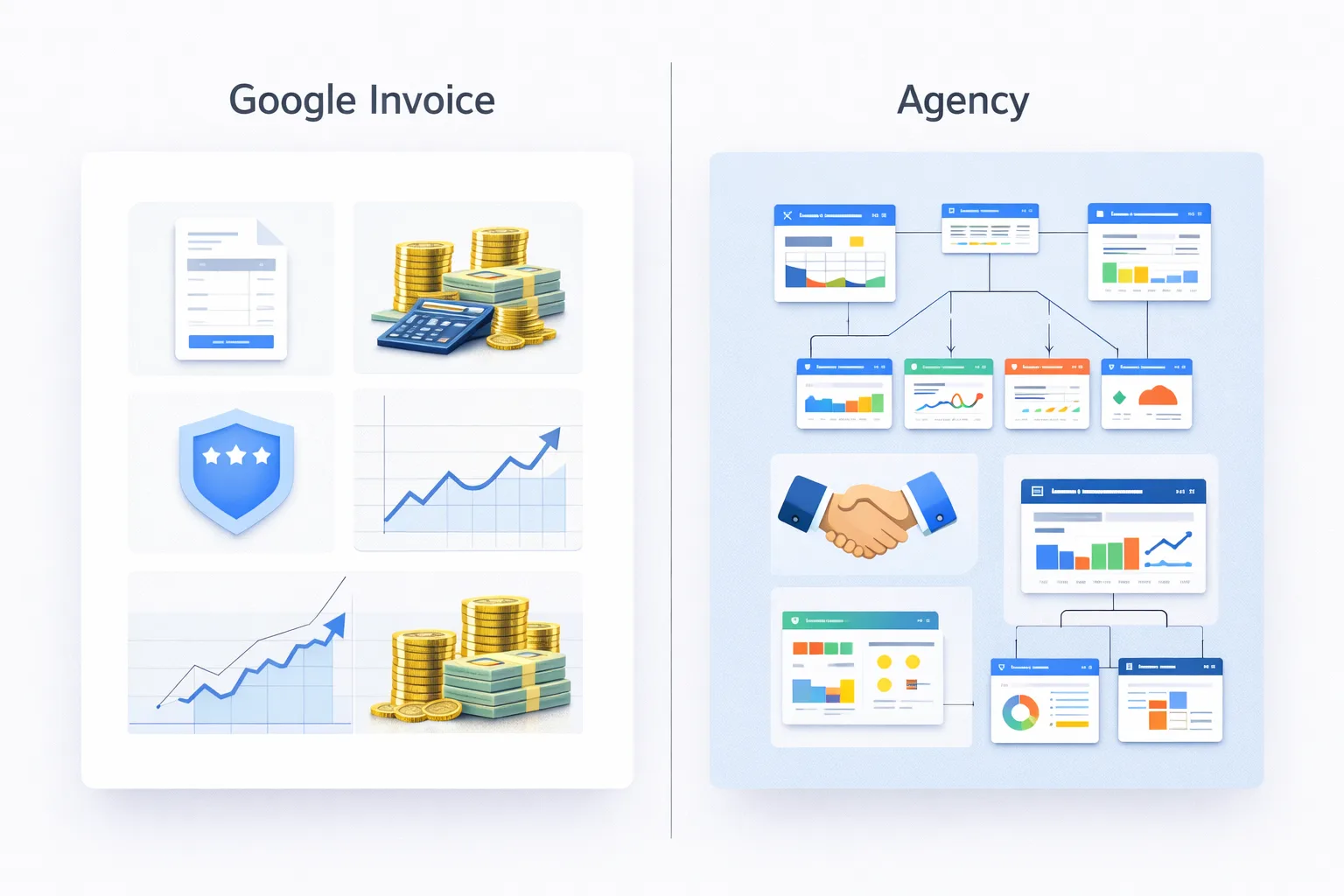
From a billing perspective, Invoice accounts stand out because of their postpaid structure and are especially suitable for businesses with large advertising cash flow. Agency accounts, on the other hand, are often more flexible in day-to-day execution, especially when you need to run multiple websites, campaigns, or clients inside one operating system.
In terms of trust and overall strength, Invoice accounts are often viewed as extremely strong because they operate under a credit-based model with tighter control standards. Agency accounts can also be very stable, especially when backed by a high-quality MCC system, but their real advantage lies in agility and adaptability rather than focusing on a single business entity.
- Invoice accounts are stronger when it comes to postpaid billing, larger credit capacity, and a more enterprise-style operating feel.
- Agency accounts are stronger when flexibility matters across multiple websites, accounts, or clients.
- Invoice accounts often fit businesses focused on one company or one main product system.
- Agency accounts are usually a better fit for teams that need scale, delegation, and faster campaign changes.
Should you choose a Google Invoice account or an Agency account?
If you are a larger business with significant spend, a structured payment process, and the goal of scaling on top of a strong and stable account foundation, a Google Invoice account is often the more suitable direction. It makes the most sense when you want long-term stability and a solid operating structure.
On the other hand, if you are an agency, a media team, or someone managing multiple projects at once, an Agency account is usually the better fit because of its flexibility and multi-account management advantages. In setups where campaigns must be split, adjusted quickly by client, and optimized case by case, Agency accounts often feel easier to operate than Invoice accounts.
- Choose Invoice if you prioritize stability, large budgets, and a postpaid billing model.
- Choose Agency if you need flexibility across multiple websites, products, or clients.
- Do not choose based only on which one sounds stronger; choose based on your actual operating model.
- The right account type will help you scale more easily than a strong account used in the wrong context.
Conclusion: which option is truly the better choice?
In reality, there is no absolute answer to whether a Google Invoice account is better than an Agency account in every case. Each one exists for a different style of operation. Invoice is more like a strong, stable solution built for larger-scale business use. Agency is more like a flexible tool designed for environments that need speed and adaptability.
The smartest way to choose is to start with your own needs: your budget level, whether you run one website or many, whether you operate as a business or an agency, and whether billing structure or flexibility matters more. Once you answer those questions clearly, it becomes much easier to identify which account type is actually worth using for the long term.
- Invoice does not replace Agency, and Agency does not fully replace Invoice either.
- Each account type performs best when matched to the right business model.
- Making the right decision early can reduce both operating risk and trial-and-error costs.
- If you want to scale sustainably, choose the account type that fits your needs instead of following hype.
Frequently Asked Questions
Is a Google Invoice account always better than an Agency account?
No. A Google Invoice account is stronger in terms of trust, credit-based billing, and large-scale stability, but it is not always the better choice. If you need flexibility across multiple clients or websites, an Agency account may be more practical.
Is a Google Agency account the same as an MCC account?
Not exactly. MCC is a management layer used to control multiple ad accounts, while an Agency account is usually an advertising resource that operates within or under that MCC system. In simple terms, MCC is the management structure, and the Agency account is the ad account resource inside it.
Should a small business use a Google Invoice account?
That depends on the actual need. If the business does not yet have high spend or a need for a specialized billing model, an Invoice account may not be the most efficient choice. In many cases, an Agency account can be more flexible and easier to deploy.
What is the biggest difference between Invoice and Agency accounts?
The biggest difference is in billing structure and operating style. Invoice accounts are built around postpaid credit-based billing, high trust, and larger-scale business use. Agency accounts are built around flexibility, multi-account management, and are usually a better fit for teams or agencies handling multiple projects.
If the goal is to scale large budgets, which account type should come first?
If your main goal is aggressive scale with strong stability at a larger level, a Google Invoice account is often the preferred option. However, if you still need flexibility across many campaigns or clients, a strong Agency account can also be a very smart choice.