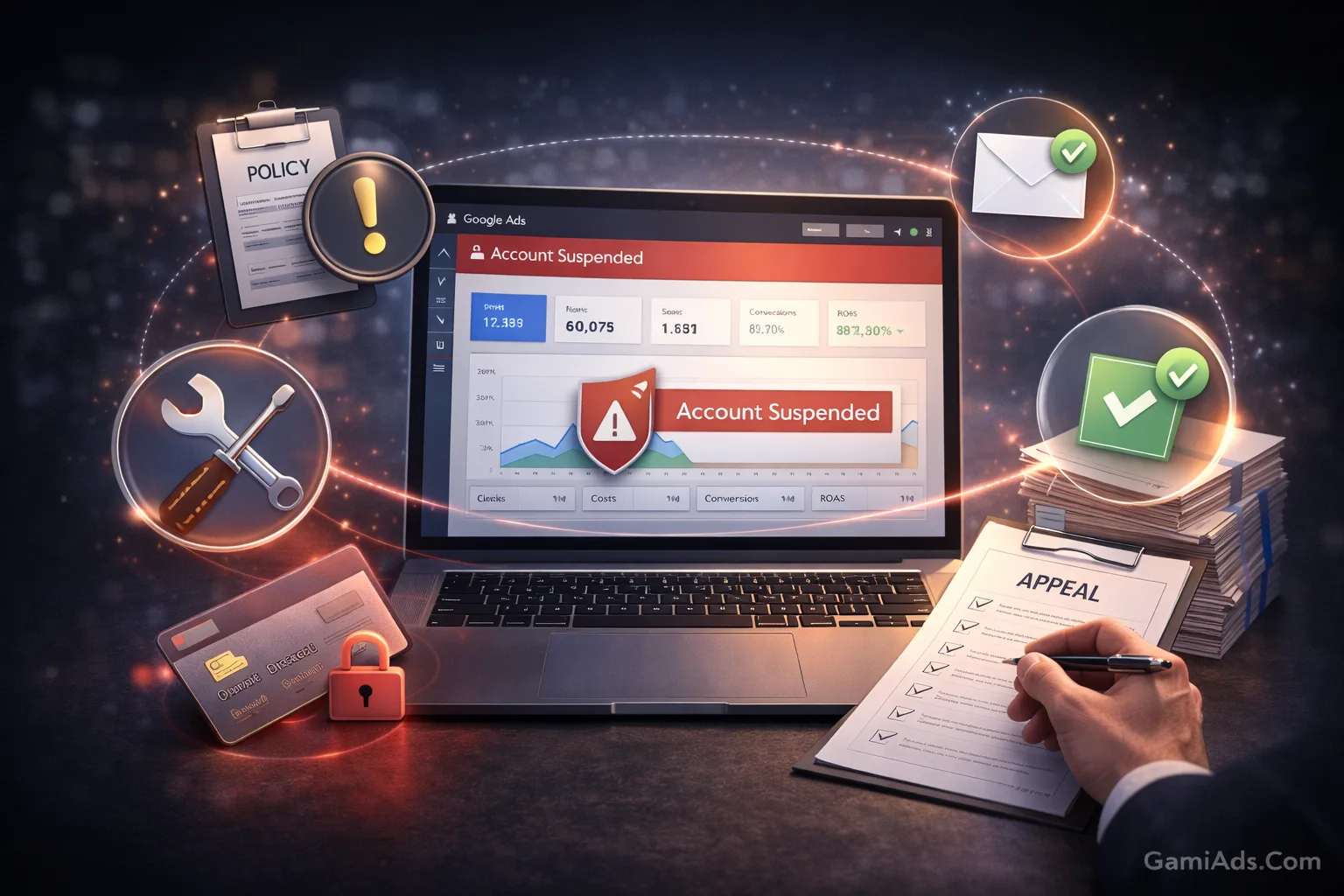
The context: why do many businesses have winning products but still fail to scale?
One of the biggest paradoxes in Google Ads is that some businesses already have a winning product, a strong landing page, and ad creatives that convert well, yet still cannot grow the way they expect. Every time they try to raise the budget, the account gets suspended, payment gets flagged, or policy-related issues appear and stop the momentum completely.
That was exactly the situation in this case study. The client was a business operating in cosmetics and supplements, a highly competitive niche that is also relatively sensitive under advertising review systems. They did not have a sales problem. The real issue was that their current ad account setup was no longer strong enough to support the pace of growth they needed.
- The product had already shown strong signs of traction and the early campaigns were performing well.
- The bottleneck was not market demand, but the account’s ability to handle scale.
- Every budget increase came with the risk of suspension or account review.
- This is a very common problem for businesses entering the scaling stage.
Where did the invisible wall at 10 million VND per day come from?
In the early stage, the client could spend around 10 million VND per day without major issues. But each time the budget started pushing toward 15 to 20 million, the account ran into problems such as suspicious payment activity, abnormal behavior flags, or a higher overall risk assessment. That created an exhausting loop: a campaign would start producing results, then the account would go down, and after the appeal process the team had to rebuild from scratch again.
What makes this important is that those disruptions did not reflect the actual quality of the campaign. The product was still converting, the landing page was still working, and the team was still optimizing effectively. The real problem was the Trust Score and the spending tolerance of the account type they were using. When the account is not trusted enough to handle rapidly increasing spend, the system goes defensive before the campaign ever gets the chance to fully take off.
- The jump from 10 million to 15–20 million VND per day was the breaking point for a standard account.
- The most common issues revolved around payment, trust, and abnormal-signal detection.
- The cycle of losing accounts cost the business both revenue and operating time.
- When the account foundation is weak, even a good campaign can get choked during the scaling phase.

The solution: why was a Google Invoice account the right fit for this scaling problem?
After analyzing the situation, the bottleneck became clear: the current ad account setup did not have enough trust to support rapidly increasing spend in a sensitive niche. Instead of continuing to patch problems on top of the old account structure, the more effective move was to transfer the winning campaigns to a more stable Google Invoice account.
The strength of an Invoice account lies in its postpaid billing model, clear credit structure, and higher level of trust in the eyes of the system. Once the team no longer had to constantly top up balance or change cards like with standard accounts, a major group of payment-related risks was reduced almost immediately. At the same time, this type of account was much better suited to larger budgets and more deliberate scaling.
- An Invoice account reduces suspicious-payment risk through a postpaid credit-based structure.
- Its higher trust level helps the account absorb stronger budget increases.
- It is better suited for businesses that need larger and more stable ad spend.
- The real fix was not tweaking the old campaign, but changing the account foundation for scaling.
The 10-day scaling roadmap: controlled acceleration instead of emotional budget pushes
Having a stronger account does not mean you can spend recklessly from day one. In this case study, the campaign transition was handled through a 10-day roadmap so the system could adapt gradually to the new account. In the first phase, the team kept the budget at a relatively safe level of around 15 million VND per day so the account could absorb the spending pattern and campaign data under stable conditions.
Once the performance signals started holding steady, the budget was increased in deliberate steps, not so aggressively that it shocked the system, but fast enough to capture the growth opportunity. From 15 million, the campaign was pushed toward roughly 22 million, 33 million, 50 million, then extended further to 70 million, 80 million, and finally 100 million VND per day. The key point was not just reaching the spend milestone, but maintaining account stability throughout the entire process.
- Days 1–2: transfer the campaign and keep the budget at a safe level.
- Days 3–5: increase spend in rhythm once the system signals and campaign data remain stable.
- Days 6–8: continue expanding to larger milestones while the account remains healthy.
- Days 9–10: reach 100 million VND per day without falling back into the account-death cycle.

The result after changing the account foundation: not just higher spend, but more control
The biggest difference after moving to a Google Invoice account was not just the daily spend number. Before that, the business operated in a defensive mindset, always worried that the account could die at any time. Once that bottleneck was removed, the team could start planning growth proactively instead of running campaigns in constant fear.
In performance terms, the daily spending ceiling expanded dramatically compared with the earlier stage, stability improved, and the revenue upside opened up at an entirely different scale. This is a very instructive lesson for many businesses: when a campaign is already winning but still cannot grow, the problem is not always the product or the media team. Sometimes it is the account holding the campaign back.
- The maximum daily spend increased dramatically compared with the earlier stage.
- Better account stability reduced the team’s operational stress around appeals and troubleshooting.
- Revenue potential increased once the campaign could scale without breaking halfway through.
- When the tool becomes strong enough, the team can move from defense to intentional growth.

Key takeaway: if you want to scale big, do not let the account type limit your growth thinking
This case study makes one thing very clear: an ad account is not just where you launch campaigns. It is the foundation that determines how far you can really go. If the account structure is not strong enough, all the optimization work above it can still collapse the moment you try to accelerate. But when the foundation is strong, a business finally has the chance to turn a winning campaign into a true growth engine.
That does not mean every business needs an Invoice account from the start. But if you already have a winning product, need to scale larger budgets, keep hitting account ceilings, or repeatedly lose campaigns when spend rises, then it is time to re-evaluate your advertising resource foundation. In many cases, investing in stability turns out to be the highest-return investment of all.
- Do not force a weak account to do the job of one built for scale.
- Once you have a winning product, the biggest bottleneck often shifts to the account and payment foundation.
- A high-quality account does not just improve stability. It improves long-term growth planning.
- If you want sustainable scale, treat the ad account as a strategic asset, not just a temporary tool.
Frequently Asked Questions
Why does a campaign generate orders, but the account keeps failing whenever the budget increases?
In many cases, the issue is not the product or the ad creative. It is the trust level and spending tolerance of the account. When spend rises too quickly relative to the account foundation, the system may treat it as risky behavior and respond with limits or suspension.
How is a Google Invoice account different from a standard Google Ads account?
The biggest difference is in billing structure and suitability for larger budgets. An Invoice account usually runs on a postpaid credit model, which reduces a whole set of risks tied to manual top-ups or repeated card changes, while also offering a more stable foundation for scaling.
Does using a Google Invoice account automatically mean you can scale to 100 million VND per day?
No. A stronger account is only the foundation. Successful scaling still requires a winning campaign, a solid landing page, a suitable account structure, and a controlled budget-increase plan. If you push spend recklessly from day one, the risk is still very high.
What kind of business should consider using a Google Invoice account?
Businesses that already spend at a larger level, keep running into budget ceilings, need more stability, or operate in sensitive niches should seriously consider it. It becomes especially relevant when the goal is no longer small-scale testing, but structured scaling.
What is the biggest lesson from this case study?
The biggest lesson is not to let your ad account type limit your growth strategy. When a campaign is already winning but still cannot scale, it is time to review the account foundation before spending more time rewriting content, adjusting landing pages, or changing targeting.